
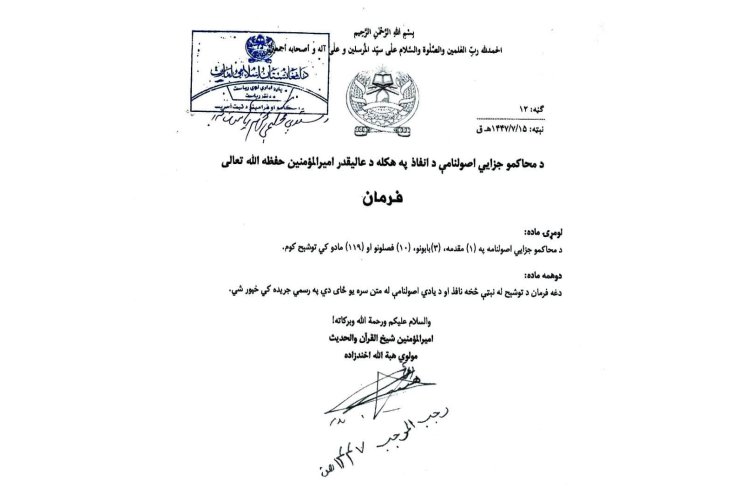
The Taliban have recently issued a criminal code, signed by their leader, Mullah Hibatullah, and sent to judicial bodies across the provinces for implementation. The code consists of three sections, ten chapters, and 119 articles, establishing a new framework for criminal proceedings in Taliban courts. It outlines definitions of crimes, methods of proof, types of punishment, and the authority of the judiciary.
Chapter One addresses discretionary punishments (ta‘zir), which do not have fixed limits, and sets the principles for their implementation. Article 1 defines “principles” and “laws” as those approved and endorsed by the Taliban leader.
Under Article 4, clause 1, fixed punishments (hudud) are executed by the “Imam,” while discretionary punishments, according to clause 5, are the responsibility of the “husband” and “guardian.” Clause 6 allows individuals to personally act against anyone they witness committing a “sin.”
The first five articles make no mention of basic rights for defendants, such as access to a lawyer, the right to remain silent, compensation for damages, or any minimum guarantees of due process. Articles 6 and 7 establish confession and testimony as the main methods of proving crimes, without specifying minimum or maximum punishments.
Article 9 divides society into social classes, including “religious scholars,” “nobility,” “middle class,” and “lower class.” The type and severity of punishment vary depending on the social status of the offender.
Articles 4 (clause 5) and 15 distinguish between “free” persons and “slaves.” Article 2 (clause 8) recognizes followers of the Hanafi school as Muslims, while followers of other religions or beliefs outside the “Sunni community” are labeled “innovators” (bid‘ah). Article 26 prohibits Hanafi followers from leaving their faith; if proven in court, the individual may face two years in prison.
Article 14 gives the “Imam” authority to approve the killing of criminals to protect the “public interest.” This includes people who defend beliefs considered false under Islam, those who invite others to such beliefs, as well as “sorcerers” and “heretics.” Clause 11 of Article 2 states that anyone acting to spread public corruption and harm cannot be corrected except by execution.
Article 16 defines insulting the prophets as “apostasy.” If proven without repentance, the judge, with the Imam’s permission, may impose both discretionary punishment and execution. If the individual repents, the judge may impose a maximum sentence of six years in prison.
Article 17 criminalizes insulting “Islamic holy days,” punishable by three months in prison. Clause 2 states that mocking Sharia laws carries a two-year prison sentence. Clause 3 specifies that anyone declaring they will not follow the instructions of religious scholars may be sentenced to two years in prison.
Article 18 declares that insulting the “Imam” is a crime punishable by 39 lashes and one year in prison. Article 19 requires citizens to comply with the Imam’s orders regarding permissible acts; refusal is considered sinful and punishable by lashes and imprisonment.
Article 24 obliges citizens to report any anti-Taliban activities. Failure to report can result in a two-year prison sentence for witnesses or informants.
Article 30 prohibits certain physical violence by teachers, such as bone fractures, skin lacerations, or bruising, but does not prohibit other forms of physical, psychological, or sexual abuse. Article 48 allows fathers to punish ten-year-old sons “for their welfare,” such as for skipping prayers.
Article 34 considers a woman criminal if she repeatedly leaves her husband’s home for her father’s or other relatives’ homes without permission and refuses to return; she may be sentenced to three months in prison.
Article 58 allows a judge to sentence a “female apostate” to life imprisonment to compel her return to Islam, including ten lashes every three days.
Article 59 states that dancers—male or female—and their audiences are criminals, punishable by two months in prison each.
Human rights organizations have warned that this code violates all basic principles of a fair trial. The rights group Rawadari emphasized that implementing this code without independent oversight could lead to increased arbitrary detention, unlawful punishments, and severe restrictions on citizens’ freedoms.