
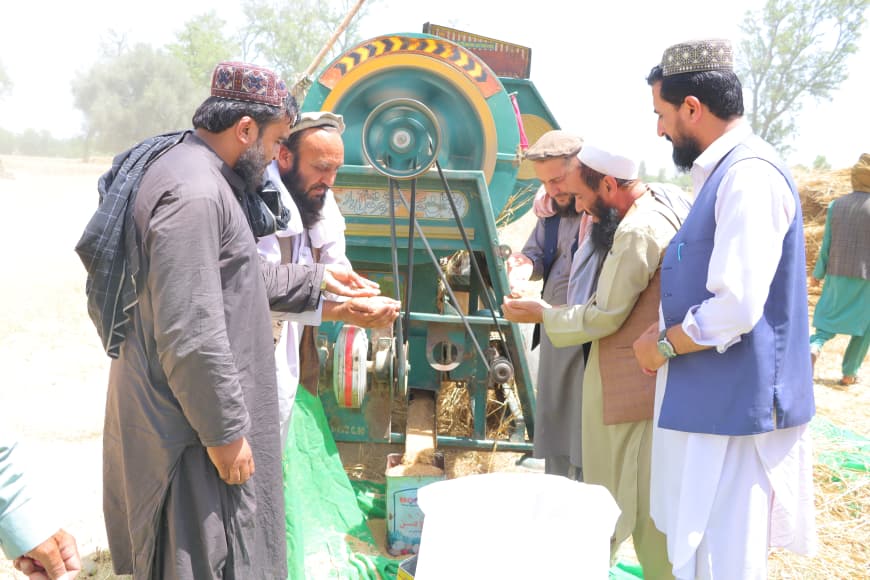
“If I also give ushr to the Taliban, what will be left for my family to eat?”
This is what Mohammad Ishaq, a farmer from Tagab district in Kapisa province, says as he describes his harvest this year—only 70 man (about 490 kilograms) of wheat, which he says was not enough to cover production costs.
He is one of thousands of farmers who say they are required to pay 10% of their agricultural output as ushr, an Islamic tithe on farm production, to the Taliban.
Local sources in several Afghan provinces told RM Media that the Taliban have recently intensified the collection of ushr across the country.
The sources said ushr and zakat are being collected as religious levies in addition to official taxes, from farmers, orchard owners, shopkeepers, and market traders. In some areas, those who refused to pay have reportedly faced threats, pressure, or arrest.
Abdul Nasser, a farmer in eastern Nangarhar province, said household economic conditions had become increasingly difficult in recent months, citing pests, heavy rain, and flooding as factors behind declining yields.
“Now is the harvest season for wheat, vegetables, and fruit, but yields are lower than last year. Despite this, the Taliban come to people’s homes and demand one-tenth of the harvest as ushr,” he said.
He added that in some districts, written notices had been issued ordering residents to pay ushr, warning that refusal could result in penalties, including detention of up to ten days, according to local sources.
In Kapisa, farmers said reduced production and rising costs had further strained their livelihoods.
Mohammad Ishaq said: “I have 12 family members. I already paid ushr to the local mosque, but now the Taliban also demand it. If I pay them too, what will my family eat?”
He added that pressure was not limited to farmers, saying shopkeepers and market owners had been instructed to pay a fixed monthly amount.
“They come to shops and markets and do not allow business to continue until payment is made,” he said.
In Laghman province, local sources said several farmers had been arrested after disputes over ushr collection. At least six farmers were detained about three weeks ago in the Kabila area of Alingar district, according to Wahidullah, a local resident.
“The Taliban demand ushr from every farmer. Those who resist face threats or arrest. People are forced to pay because they fear the consequences,” he said.
Taliban officials say ushr and zakat collection is carried out under a formal framework.
Saif-ul-Islam Khyber, spokesperson for the Taliban’s Ministry for the Propagation of Virtue and Prevention of Vice, said the ministry has a clear policy for collecting ushr and zakat, generating millions of Afghanis in revenue each year.
He claimed the revenues are redistributed among needy families.
Farmers and residents in several provinces say the pressure of ushr collection has increased at a time when Afghanistan is facing a severe economic crisis, widespread unemployment, and falling incomes.
Many households struggle to meet basic needs, while declining agricultural yields have deepened hardship.
Humanitarian agencies estimate that nearly 22 million people in Afghanistan require assistance to meet basic needs.