
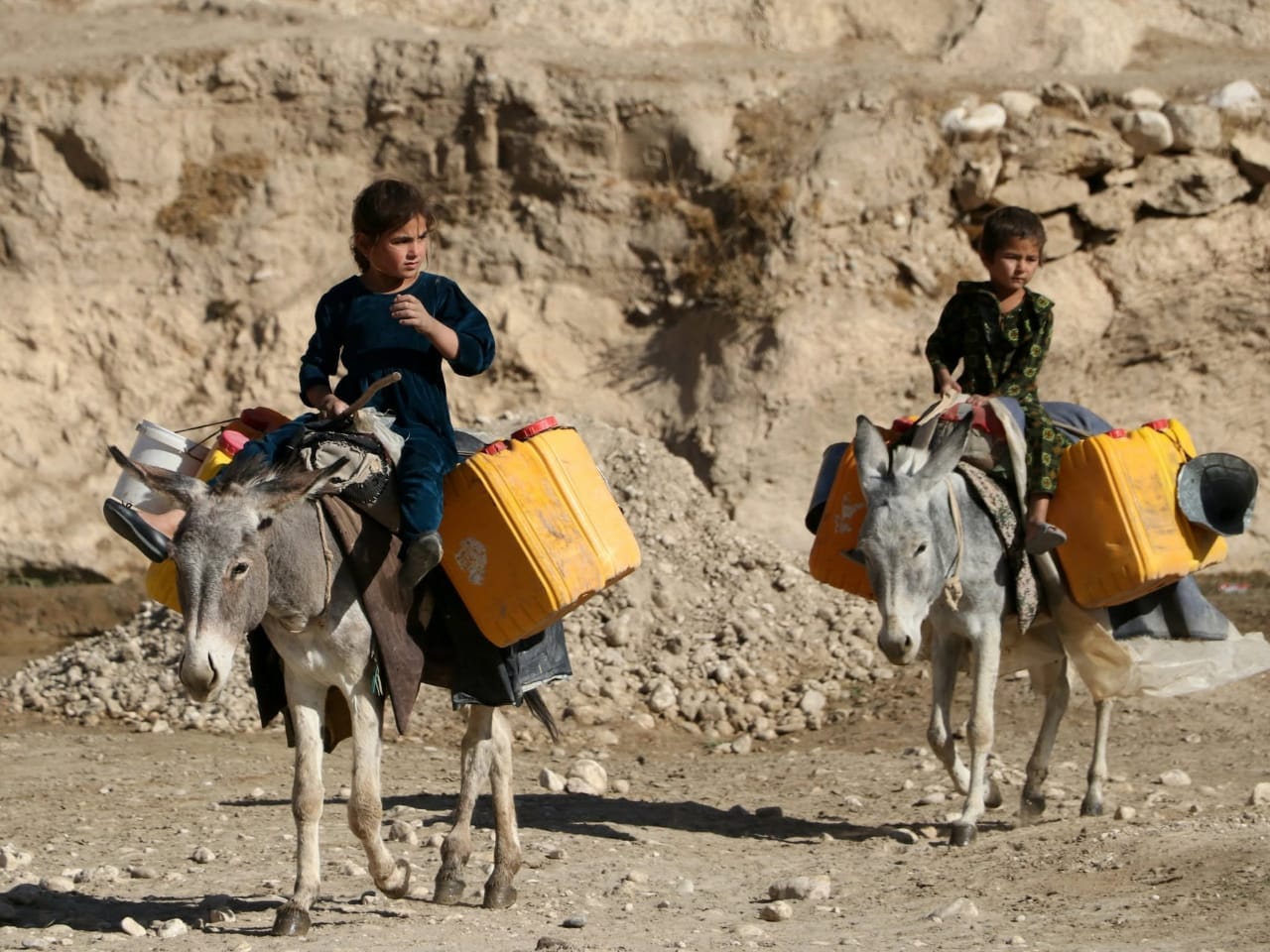
Years of drought, rapid urbanization and the relentless depletion of groundwater have pushed Afghanistan’s capital to the brink of a severe water crisis, leaving thousands of families struggling to secure safe drinking water.
Home to an estimated six million people, Kabul is facing an acute water shortage. Even the water that remains available is often contaminated, making it unsafe for drinking.
Nazifullah, a 70-year-old resident of Ahmad Shah Baba township, remembers a time when clean water was plentiful.
“This area used to have fresh air and abundant water,” he says. “Now, most household wells have dried up.”
As groundwater levels continue to fall, many residents have been forced to drill their wells ever deeper. Families who cannot afford the cost of drilling new wells often have no choice but to collect water from neighbors in buckets and plastic containers.
“There was a time when you could find groundwater just 10 meters below the surface almost anywhere in Kabul,” Nazifullah says. “I recently drilled a 90-meter well at my house, but it still came up dry.”
He blames the crisis on a combination of rapid population growth, recurring drought, declining snowfall and rainfall, the expansion of residential areas onto agricultural land, the absence of an effective sewage system, and the loss of green spaces. According to him, the widespread drilling of increasingly deeper wells has placed enormous pressure on Kabul’s underground aquifers.
Nazifullah says authorities once prohibited drilling two wells within 100 meters of each other. Today, however, wells are often dug only five to ten meters apart, accelerating the depletion of already fragile groundwater reserves.
He also warns that much of Kabul’s groundwater is contaminated with chemicals and bacteria, exposing residents to serious health risks.
“In the past, there were strict limits on drilling wells,” he says. “Now almost every street has one or two. Neighbors can no longer help each other because everyone is facing the same shortage. If urgent action isn’t taken, Kabul will face an even deeper water crisis.”
For many low-income families, the crisis extends beyond access to water. Buying drinking water has become a significant financial burden, forcing households to spend a large share of their monthly income on one of life’s most basic necessities.
Sayed Gul, a resident of Kabul’s Khair Khana neighborhood, says the rising cost of water has become one of his family’s biggest financial burdens.
Alongside other household expenses, he spends between 5,000 and 6,000 Afghanis (roughly $80–95) every month on water alone.
“Our old well used to provide water from a depth of about 40 meters,” he says. “We deepened it to 150 meters, but it still kept drying up. Now it has been completely dry for nearly a month. Every day we buy bottled drinking water for 40 to 50 Afghanis, and every two days we pay around 200 Afghanis for a water tanker. Altogether, we spend more than 6,000 Afghanis a month just to secure water for our family.”
The crisis is not confined to Kabul’s urban neighborhoods. Residents of Shakardara district, on the outskirts of the capital, say years of below-average rainfall and recurring drought have dramatically reduced the flow of natural springs that once supplied local communities.
Ajmal, a resident of Shakardara, says springs that had long met the daily needs of villagers are now producing only a fraction of their former flow, forcing some families to travel long distances to collect water.
“These springs once provided more than enough water for everyone,” he says. “Today, the water level has dropped significantly, and our daily lives have become much more difficult.”
The United Nations Children’s Fund (UNICEF) has warned that Kabul could run out of groundwater by 2030 unless urgent action is taken.
According to UNICEF, rapid urbanization and climate change are the main drivers of the crisis. The agency has described Kabul’s worsening water shortage as a humanitarian emergency and has called for immediate, coordinated action to protect the city’s rapidly declining water resources.
The warning echoes concerns raised by The Guardian, which reported that Kabul is approaching a severe and potentially irreversible water crisis.
According to the newspaper, groundwater levels in the Afghan capital have fallen by an estimated 20 to 30 meters over the past decade. At the same time, water extraction has far exceeded the aquifers’ natural recharge rate, accelerating the depletion of underground reserves.
For many Kabul residents, the crisis is no longer a warning about the future—it has become part of everyday life.