The transformation of Afghanistan’s higher education system over the past five years has gone far beyond the dismissal of professors and the ban on women’s education. The Taliban have introduced new rules governing the appearance and conduct of students and faculty. They have expanded religious instruction and changed university textbooks, curricula, and course content. Together, these measures have reshaped both daily life on university campuses and what students are taught.
Controlling Appearance and Conduct
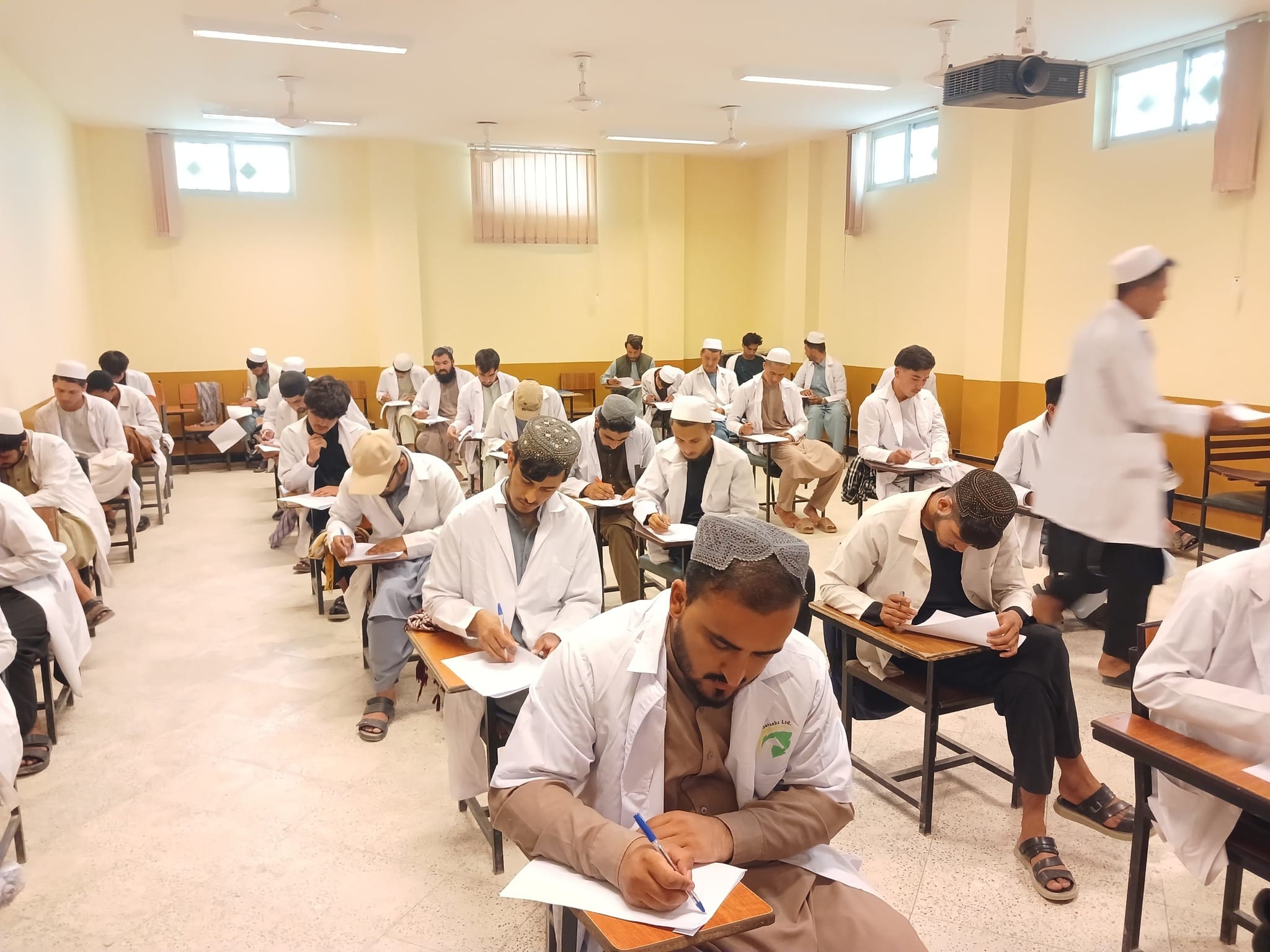
One of the first areas in which the Taliban introduced explicit rules on university campuses was the appearance and conduct of students and faculty. In some cases, these rules were communicated through written directives. They covered beards, clothing, headwear, and attendance at congregational prayers.
In October 2024, the Taliban’s Amr bil Ma‘ruf wa Nahi anil Munkar department in Badakhshan issued a written directive to the provincial university. It ordered male students to wear traditional Afghan clothing and caps. It also instructed faculty members, students, and staff not to trim their beards. The directive required them to attend congregational prayers. It warned that the names of those who failed to attend would be sent to the provincial Da‘wa and Irshad Committee.
The rules have also been enforced through monitoring and disciplinary measures. In October 2024, officials from the Taliban’s Amr bil Ma‘ruf wa Nahi anil Munkar department warned professors, deans, and department heads at Herat University. According to sources who attended the meeting, professors were told that they had to grow beards and attend congregational prayers. Those who failed to comply could face punishment, including imprisonment.
On August 20, 2026, eight professors from Herat University’s Faculty of Medicine were detained by officials from the Amr bil Ma‘ruf wa Nahi anil Munkar department, according to local reports. The professors were reportedly detained for having short or no beards. They were held in a container for about an hour.
For students, these rules have even been linked to access to university dormitories. A September 2025 RM Media investigation found that some students at public universities had been expelled from dormitories for not having beards. Students in several provinces told RM Media that growing a beard, wearing a turban, and attending congregational prayers had become conditions for keeping a dormitory room. Some students were denied accommodation for failing to comply.
The restrictions continued in 2026. In June, local sources reported that several students at Sheikh Zayed University in Khost had been expelled from the university dormitory for not having beards.
In Kandahar, students told Afghanistan International that officials from the Taliban’s Amr bil Ma‘ruf wa Nahi anil Munkar department had removed students from classrooms and barred them from taking exams because they had shaved or trimmed their beards.
A July 2026 report by The Guardian documented similar restrictions in several provinces. Based on interviews with more than 20 students at universities in seven provinces, the report found that male students were required to grow beards, wear traditional clothing, attend prayers, and participate in religious programs. Students also described tighter religious controls and less room for discussion and questioning on campus.
Imposing a Religious Framework
Religious controls have extended beyond students’ appearance and conduct. In early 2026, the Taliban’s Ministry of Higher Education distributed a 14-point pledge at universities. The document required students to follow a range of religious and behavioral rules.
Under the pledge, students were required to style their hair and beards according to Taliban directives. They were also required to wear traditional Afghan clothing and not appear without a cap or turban. The pledge prohibited listening to music and viewing images of living beings. Article 6 required students to follow the Hanafi school of Sunni Islam.
Reports based on copies of the pledge indicate that the Ministry of Higher Education distributed it at several public and private universities. In May 2026, Amu TV reported, citing documents and sources, that more than 10,000 students at universities in western Afghanistan had been compelled to sign the pledge.
A copy of the same pledge was also circulated at Kabul University. Article 6 requires students from other religious traditions, including Shia Muslims, to declare their adherence to the Hanafi school. The stated reason is to “preserve the unity and solidarity of the Muslim community.”
The same approach can be seen in the treatment of other religious traditions. In December 2023, the Taliban’s Ministry of Higher Education instructed universities and private higher education institutions to remove books deemed incompatible with Hanafi jurisprudence from their libraries. The books included works dealing with Shia beliefs.
Expanding Religious Education
During the former republic, the university course Islamic Culture carried eight credits in many four-year degree programs. After returning to power, the Taliban’s Ministry of Higher Education increased the requirement to 24 credits.
Other changes in religious instruction have also been reported in some programs. The courses cover subjects including Islamic beliefs, worship, the life of the Prophet Muhammad, ethics, and Islamic social, political, and economic systems.
Banning Books
Changes to higher education content have not been limited to the curriculum. In August 2025, the Taliban’s Ministry of Higher Education issued a directive to public and private universities. It ordered them to stop using and teaching 679 textbooks and academic reference works.
According to the directive, specialized committees had reviewed the materials before they were placed on the banned list. Their contents were assessed from doctrinal, ideological, religious, policy, cultural, and academic perspectives. The list was included in a 50-page annex to the ministry’s directive.
Among the banned works were 140 books written by women. The list also included books dealing with democracy, human rights, women’s rights, good governance, development, political science, and social issues. Reports also identified hundreds of works by Iranian authors or publishers.
A 2026 report by the European Union Agency for Asylum (EUAA) documented the removal of around 680 books described as “conflicting with Sharia” from university curricula. The report noted that many were authored by women. It also cited a Taliban spokesperson’s confirmation to BBC News that books written by women were not permitted to be taught at universities.
Removing and Revising University Courses
The changes have also affected university courses. According to an August 2025 directive issued by the Taliban’s Ministry of Higher Education, religious scholars and Sharia experts reviewed university curricula.
Following the review, 18 courses were removed. The ministry described them as incompatible with Sharia and the “system’s policies.” Another 201 courses were identified as having “relative problems.” The ministry ordered that they be taught temporarily in revised form.
The list of the 18 removed courses shows that many were related to the humanities and social sciences. They included “Constitutional Law of Afghanistan,” “Islamic Political Movements,” “Good Governance,” “Electoral Systems,” “Afghanistan’s Political System,” and “Political Sociology of Afghanistan.”
Other removed courses included “Gender and Development,” “Human Rights and Democracy,” “Analysis of the Constitution of Afghanistan,” “Globalization and Development,” “Sociology of Women,” and “Moral Philosophy.”
The list also included courses on “Sexual Harassment,” “Gender Diversity in Employment,” “Gender Communication,” and “The Role of Women in Public Communication.”
A Shrinking Academic Space
The changes described in this report extend from students’ appearance and daily conduct to the religious content of university education and the materials available to students.
Alongside the dismissal and reassignment of professors documented in the earlier reports in this series, these measures have changed both the environment in which students study and the content they are taught. They have also reduced the space for open discussion and critical inquiry within Afghanistan’s universities.
Taken together, the evidence points to a higher education system in which religious rules increasingly shape campus life, while changes to books and academic courses narrow the range of subjects and perspectives available to students.