
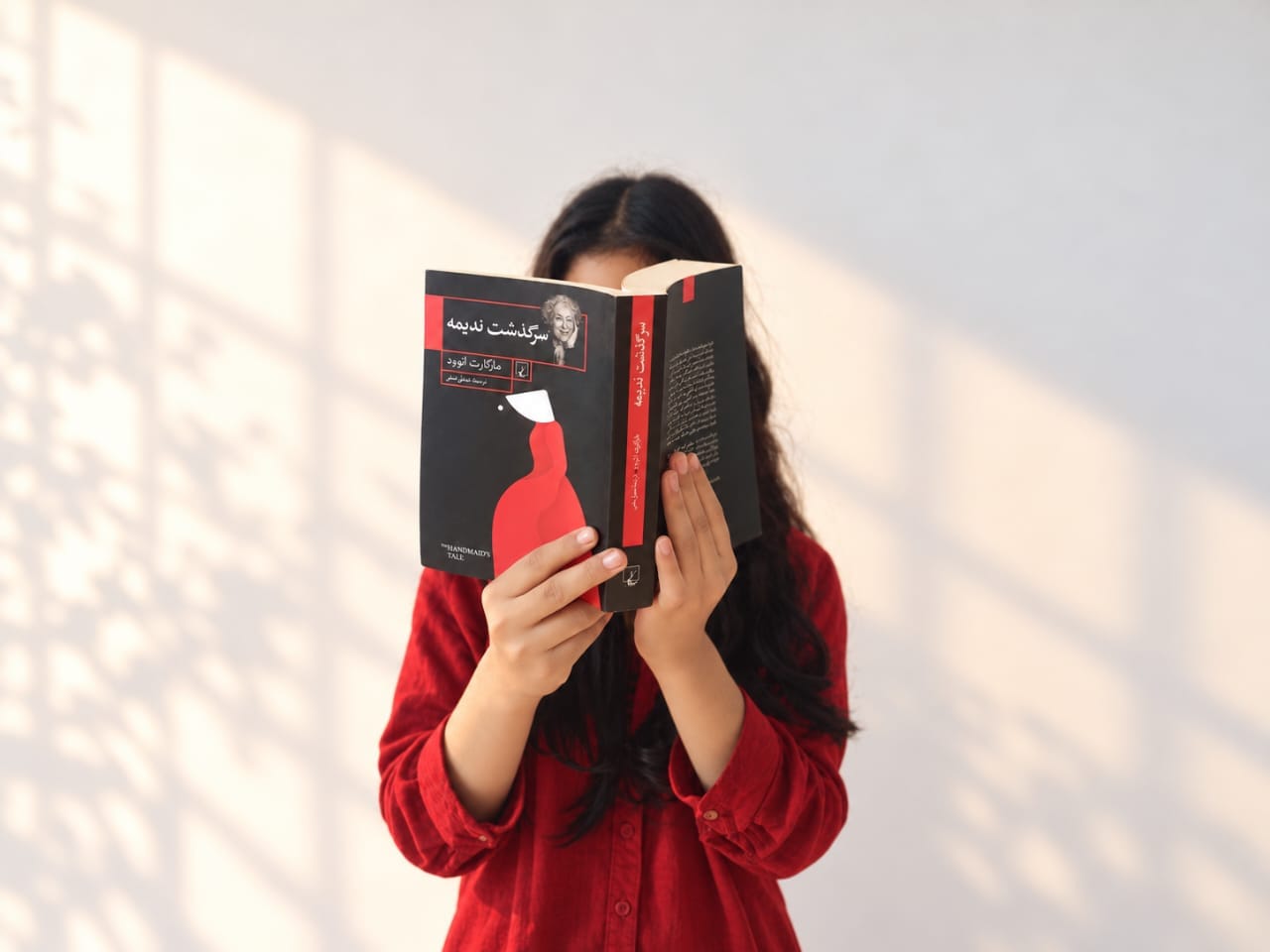
I turn the page. Three pages left.
“What could possibly happen in these last three pages?” I whisper to myself. “How can the author bring such a long story to an end in so little space?”
I start reading, but my mother calls from the other room.
“Hurry up and go to the shop. It’s already eleven, and I haven’t even started making lunch. Your brother will be home soon, hungry and thirsty.”
I’m at the most suspenseful part of the book. I sit cross-legged, too anxious to keep still, and call back, “Mom, please wait! I’m coming. Just give me two minutes. I’m on the last page!” As I read, I rock back and forth, unable to contain my anticipation.
One page left. God, what is going to happen? My mouth has gone dry. I glance at the window and realize I’ve forgotten to open it. The room feels as though it has run out of air.
I turn the page. I’ve reached the end.
My mother calls again. “God help anyone who ever has to depend on you! The book isn’t going anywhere. Go and get my groceries. After that, you can stay up reading until tomorrow morning for all I care. Don’t eat, don’t sleep, just read your book!”
I read the final paragraph once more. I can’t believe it. I close the book and run my fingers over its stiff red cover. I look at the title: The Handmaid’s Tale.
But shouldn’t a person’s story follow them all the way to death? Shouldn’t it tell us how they die, too? Why has this story ended at its most crucial moment? Why has it left me with so many unanswered questions?
I put the book down and leave my room to listen to my mother’s instructions. She needs eggs, eggplants and potatoes. I try to memorize the list through the noise still swirling inside my head.
I put on my face mask and look in the mirror. I pull it up until it nearly reaches my eyes, then wrap my black scarf tightly around my head. My mother stands in the doorway. I take the chador and money from her. She has set aside fifty afghanis for eggs and twenty for eggplants. She also wants a kilo of potatoes.
In the novel, Offred is given money for shopping in much the same way: only what she needs, with nothing left over. Everything is calculated. A certain amount for chicken, another for eggs, and so on.
I step outside. “If there’s any money left,” my mother calls after me, “get a little butter too.”
I don’t ask why. My brother has probably asked for some to eat before going to school. There are no shops on our street. The nearest one is some distance away, which is why my mother has sent me.
I have barely taken a few steps when sweat begins soaking through my clothes. I can hardly lift my head. Today, the sun seems determined to kill everyone beneath it.
I pull my chador closer around my face and adjust my mask. I cross the road and head toward the main street. Cars race past. One comes speeding toward me, as though the driver has never considered that he might kill someone.
My thoughts return to the book. Where are you now, Offred? What happened to Gilead in the end? I wish someone could answer all the questions in my head.
Last night, my friend asked whether I had finished the book.
“Not yet,” I told her. “But I definitely will tomorrow.”
I told her how eager I was to find out how it ended. I imagined that the people resisting Gilead’s government, those who defied its laws, might eventually bring the regime down. Perhaps freedom would return.
My friend laughed. “You’re too optimistic,” she said. “You always expect stories to end well.”
Now I understand what she meant.
Today, I feel like one of Gilead’s handmaids. I have been given just enough money for the groceries, told exactly what to buy, and sent out with my body covered and my head lowered.
I can almost feel Offred walking beside me. Her head is bowed, too. She is going shopping, just as I am. Her clothes make walking difficult. I struggle to move freely beneath my chador. Her face is framed by a white bonnet that limits her view to what lies directly ahead. Beneath my mask, little of my face is visible beyond my eyes.
I lower my head further. I want to understand what Offred feels. Hopelessness, fear, sadness, resentment toward the world around me: these are my feelings. But I cannot know exactly what she feels.
Perhaps every time she went shopping, she, too, was searching for something. Freedom. The end of Gilead.
I reach the shop and pause at the entrance. Another woman is inside, dressed entirely in black.
A large black chador covers her from head to toe. Unlike mine, which hangs loosely, hers is sewn together at the front like a garment. A thin black veil covers her face, while another piece of fabric reaches down to her eyebrows. Only her eyes are visible. Even her hands are covered in black gloves.
Fear takes hold of me. This is exactly what they want us to wear: clothing that leaves nothing visible but our eyes.
If her clothes were red and she wore a white bonnet, she could be Offred. Or Janine. Or any of the other handmaids.
I ask the shopkeeper for eggplants, potatoes and eggs. I look around. Barrels of cooking oil and sacks of rice are stacked in one corner.
The woman beside me asks about the price of rice. She grows irritated, complaining about how expensive everything has become. There is something strangely oppressive about her presence. I feel afraid.
I have heard reports of women associated with the ruling authorities patrolling the city, inspecting other women’s clothing and identifying those accused of violating Islamic dress requirements, who may then be detained.
I pull my mask higher. Its edge brushes against my eye, making it sting. A little boy working in the shop hands me my groceries, packing each item into a separate plastic bag.
I wish I had a shopping basket like Offred. It would make carrying everything so much easier.
“Anything else?” the boy asks.
I shake my head. I am afraid to speak in front of this woman. It feels as though I am a handmaid and she is one of Gilead’s Aunts.
The boy holds out my remaining twenty afghanis. Then I remember the butter.
“Do you have any butter?” I ask quickly. “Give me whatever I can get with the change.”
I gather the plastic bags in one hand and grip my chador tightly with the other. As I step outside, I hear the woman in black speaking to me.
“Your hair is showing at the front. Cover it. Men outside your family shouldn’t see it.”
I want to give her a sharp answer, but fear stops me. I say nothing and start walking home. How did she even notice that my hair was showing? Then I answer my own question. That is what she gets paid to do.
I pass a butcher’s shop. The butcher has just hung freshly slaughtered sheep from metal hooks. Men and women stand outside, waiting to buy fresh meat. The carcasses hang in a row.
The sight reminds me of a scene from the novel: the bodies hanging on the Wall, where Gilead displays those it has executed.
I feel Offred beside me again. She is looking at the same scene. Perhaps she, too, is remembering the doctors whose bodies were left hanging on the Wall.
I whisper to myself, “We take pleasure in watching a living creature being hanged. Only last year, several innocent people were hanged in Chowk-e-Gulha.”
People gathered to watch. They came to witness the hangings, even though everyone knew the men were innocent. Perhaps those men were like the doctors in Gilead. Perhaps all they had wanted was to help.
The heat is making my head throb. I reach the intersection and cross the road. I remember the butter again.
Perhaps I should save a little for Offred, so she can rub it into her hands and feet. Or perhaps I should try it myself, just once, and rub some into my face and hands. I quicken my steps so the butter will not melt.
A motorcycle approaches from the opposite direction. Two men are riding it. Both carry guns. Their eyes are lined with dark kohl, their clothes are dirty, and their beards are long. They stare at me.
I do not want to meet their eyes. I lower my head as they pass. Then I turn to watch where they are going.
A box is attached to the back of the motorcycle, much like the delivery boxes used by restaurant couriers. But instead of a restaurant’s name, address and telephone number, there is a single word written on it: Police.
Police. What a strange, unfamiliar word it has become. I cannot remember the last time I wrote it or even read it.
I breathe out. Warm air gathers beneath my mask and brushes against my face. There is not the slightest breeze today.
I turn into our alley and loosen my grip on my chador a little. Looking to my right, I notice two motorcycles parked outside a neighbor’s house. They look just like the one that passed me earlier.
A woman wearing a chador but no mask is crying uncontrollably, beside herself with distress. I cannot make out what she is saying. Three or four men are standing beside a large white vehicle, the kind used to transport detained women.
I am afraid to look any longer in case someone notices me. I keep walking.
Behind me, I hear two girls approaching from the other end of the alley. They are talking quietly, their heads lowered. Neither is wearing a mask.
I raise my hand to get their attention. One of them notices me and looks puzzled. I pull down my mask and whisper a single word.
“Taliban.”
At the same time, I gesture toward the adjoining alley. They seem to understand immediately. They pull up their masks, draw their chadors closer and hurry past.
I enter our house. Our home looks nothing like the Commander’s house, yet I feel as though I have stepped inside it. Offred is everywhere.
“Save some of the butter for me,” I tell my mother. “I need it for something.”
I take off my scarf and chador and put them aside. Then I walk slowly toward my room, imagining Offred’s footsteps. The window is open, and a breeze stirs the white curtain.
I pick up The Handmaid’s Tale and sit beside the window. I have to write about it. I have to write so I will never forget, so Offred will stay with me forever.
Suddenly, I feel as though someone is watching me from the alley. I lean out of the window. I hear shouting and screaming, but I cannot see anyone.
I pull back and hold the book against my chest. “I can feel you everywhere, Offred,” I whisper. “I wish I knew what happened to you in the end.”
I take out my notebook and pen. This is a good time to write about the book.
Before I can begin, my mother rushes into the room. Her face has gone pale.
“Has something happened?” I ask. “Why is it so noisy outside?”
“They’re taking that poor girl away by force,” she says.
“Why?” I whisper.
“I don’t know exactly. They say she was wearing a coat and didn’t have a chador or a mask.”
The noise outside grows louder. I move past my mother and look into the alley.
Two women dressed in black, just like the woman I saw in the shop, are gripping a young girl by the arms and dragging her toward the vehicle as she cries.
“I haven’t done anything!” the girl screams.
Everyone is silent. Nobody intervenes.
My mother murmurs sadly, “If only she had worn her chador. We all know what these people are like. Why defy them and put ourselves in danger? Poor girl. God knows what will happen to her.”
The alley begins to change before my eyes. It is no longer the alley I know. Everything has turned red. There are no women in chadors anymore. Every woman is dressed as a handmaid, standing motionless, watching the scene without expression.
Offred is there. She stands among them, her back against a wall. Tears stream down her face as she looks at me.
“I haven’t done anything,” she whispers.
I clutch the book tightly against my chest. My own tears begin to fall. They are taking the girl away. Offred is crying, too.
“I haven’t done anything. Please, save me.”
Then she disappears before my eyes. My mother closes the window. I am left alone in the corner of my room with The Handmaid’s Tale.
I do not know how many hours pass before I finally stop crying and get up. I cry for myself, for the teenage girl next door, and for Offred, whose fate I still do not know.
I fetch the butter. I press a small piece between my hands until it softens. My hands become greasy, and I rub the butter over my face.
I imagine Offred in her room, rubbing butter into her hands and face. She does not look sad. Something so small has made her happy.
I remember how she describes her evening ritual in the novel. After returning to her room, she changes into her nightgown and retrieves a piece of butter she has hidden in her shoe after dinner. The cupboard is warm, and the butter has almost melted, much of it clinging to the napkin wrapped around it.
She rubs it into her face. There are no hand creams or moisturizers anymore, not for women like her. Such things are considered signs of vanity and pride.
I walk toward the window. The whole room smells of butter. My skin is greasy. I open the window and look out into the darkness.
Like Offred, I have a window in my room. At night, I sit beside it and stare at the sky. The sky is red. It has taken on the color of fertility.
In the darkness, I see Offred again. Nick is there. So is the Commander, along with everyone else in the household. Two men are leading Offred toward a vehicle. She is crying as they take her away.
“I haven’t done anything,” she whispers. “Please, for God’s sake, save me.”
They take Offred away. And I remain by the window, staring into the darkness of the night.
By Shahla Sameh
