
Table of Contents
16 Days, 16 Forms of Gender-Based Violence, 16 Questions on Justice
The global 16 Days of Activism against Gender-Based Violence campaign runs from 25 November, the International Day for the Elimination of Violence against Women, to 10 December, Human Rights Day. This year, the UN campaign emphasises access to justice, support for survivors, and an end to impunity.
Over these 16 days, we look at 16 less visible forms of gender-based violence and what they mean for women seeking justice in Afghanistan. What does the law say? What do the data tell us? And what barriers do women face when they try to stop the abuse and pursue a complaint?
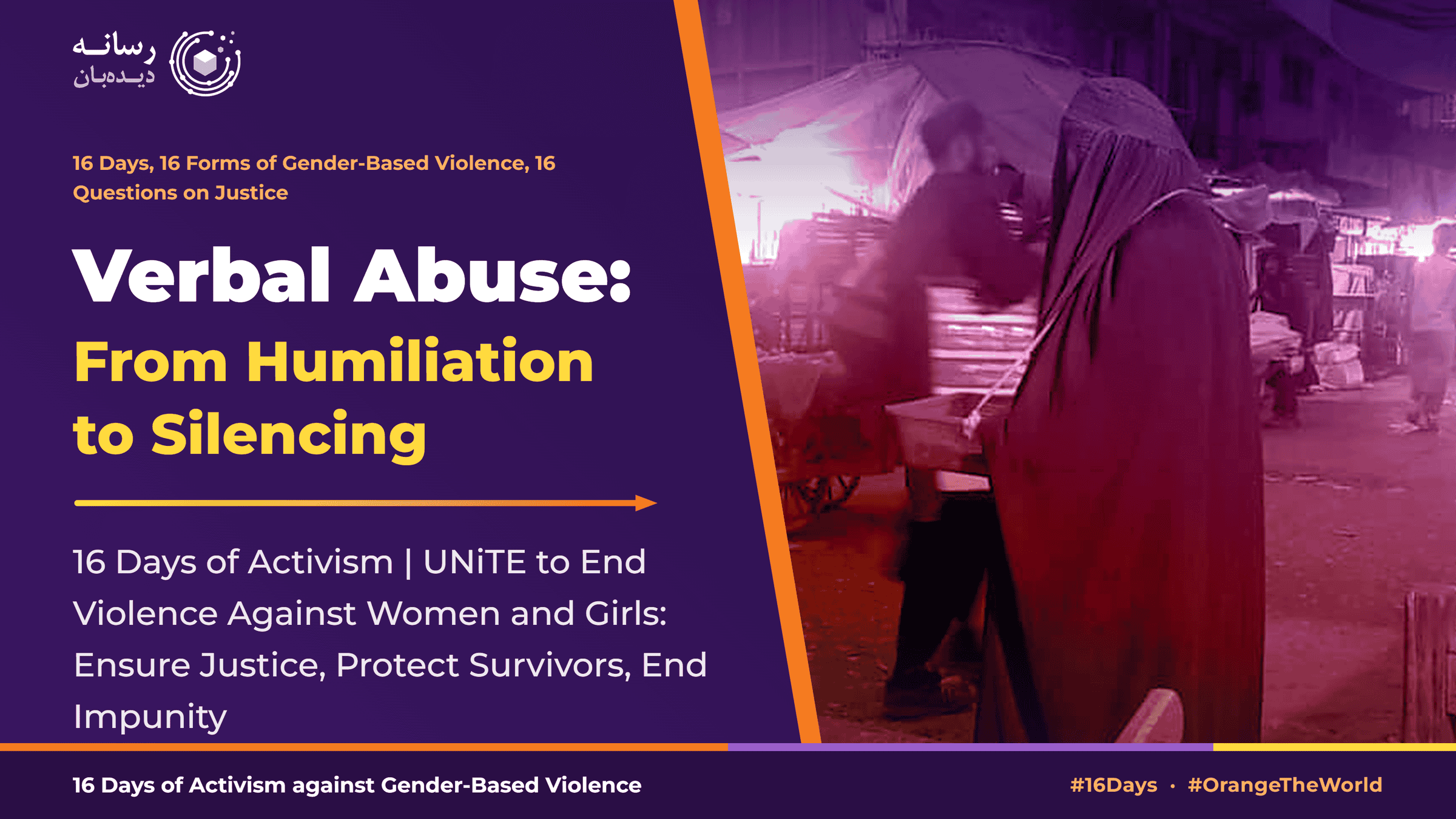
Day 1 | Verbal Abuse: From Humiliation to Silencing
“If you file a complaint, we will ruin your reputation.”
A threat like this can silence a woman before she ever files a complaint. If it comes from a relative or someone close to her, she may depend on that person for a place to live. If it comes from an employer, her job and income may be at risk. And if it comes from a Taliban official, she may have to take her complaint to an institution where the person who threatened her holds authority.
Men and boys can experience verbal abuse too. It becomes gender-based when someone is targeted because of their gender, or when gender norms and stereotypes are used to humiliate them or restrict their choices. This can include blaming a woman for giving birth to a girl, shaming her for not having children, or taunting her for going to court to report violence.
Some of these behaviours are so familiar in families and communities that people may overlook them as forms of violence. A girl might be told, “A respectable girl from a good family would never dress like that.” A woman might be shamed for remaining unmarried or mocked for her appearance, age, or personal choices. Such remarks may pass for jokes, advice, or everyday conversation. They can also humiliate women, enforce gender expectations, and control how women behave and what choices they make.
The UN Committee on the Elimination of Discrimination against Women defines gender-based violence against women as violence directed against women because they are women or that affects them disproportionately.
Verbal abuse can also be part of a broader pattern of coercive control and violence. By repeatedly humiliating and threatening a woman, an abuser can undermine her confidence, restrict her independence, and pressure her into doing what they want.
What Forms Can Verbal Abuse Take?
Verbal abuse can take many forms, from name-calling and ridicule to threats and attempts to damage a woman’s reputation. Common examples include:
- Insults and name-calling. Using offensive language or degrading labels to attack a person’s dignity.
- Humiliation and ridicule. Belittling someone in private or in front of others, for example by repeatedly mocking or blaming a woman for not having a son.
- Threats and intimidation. Shouting at a woman to silence her, or threatening to harm her, fire her, or keep her from seeing her children to stop her from speaking out or filing a complaint.
- Sexualised insults and attacks on reputation. Using sexually degrading slurs, making humiliating sexual jokes, or spreading rumours about a woman’s private life to discredit her with her family, colleagues, or community.
The Situation in Afghanistan
In October 2025, the Women and Children Research and Advocacy Network (WCRAN) published findings from a survey of 600 women across ten provinces in Afghanistan. Of those surveyed, 36.7 per cent said they had experienced violence themselves, and 56.4 per cent said they had witnessed violence against women. Psychological violence was recorded in 68 per cent of cases, economic violence in 61.4 per cent, and verbal violence in 47.9 per cent. These categories overlap because respondents could report experiencing or witnessing more than one form of violence.
Interviews conducted for the report also describe verbal abuse within families. One respondent said:
“Yes, nothing is worse than the verbal and psychological abuse we hear, especially the abuse inflicted on us by our families simply because we are girls. Poverty and unemployment are also contributing factors.”
The survey identified several barriers to reporting violence. Almost two-thirds of respondents (63.9 per cent) cited the lack of legal protections for survivors. Nearly half (49.3 per cent) pointed to the lack of institutions that address gender-based violence, and 44.7 per cent cited fear of further violence. Another 41.3 per cent were concerned about protecting their family’s honour and privacy.
Where Does the Path to Justice Break Down?
Under the Republic, Afghanistan’s Law on the Elimination of Violence Against Women explicitly recognised “insult, humiliation and intimidation” as forms of violence against women in Article 5(13). Article 29 set out penalties for these acts.
After the Taliban returned to power, the legal and institutional protections available to women weakened sharply. In its 2025 concluding observations, the UN Committee on the Elimination of Discrimination against Women raised concerns about the dismantling of specialised bodies that protected women and handled cases of violence, as well as restrictions on women’s access to legal and support services.
Knowing where to turn is itself a barrier. In the WCRAN survey, 91.4 per cent of respondents said they did not know of any appropriate formal or informal channels for pursuing a case of gender-based violence. Only 8.6 per cent knew of such channels.
Seeking redress can be especially difficult when the complaint concerns a Taliban official. In its August 2026 report, the United Nations Assistance Mission in Afghanistan (UNAMA) identified bodies such as the Complaints Hearing Commission within the Taliban’s Ministry for the Promotion of Virtue and Prevention of Vice, which receives complaints against Taliban officials and institutions. UNAMA reported that some complaints remained unresolved. Fear of retaliation, distrust of the authorities that handle complaints, and restrictions on women discourage them from coming forward. The lack of female staff in many of these bodies makes it harder for women to seek help safely.
Verbal abuse can be easy to dismiss. When it is used to threaten, humiliate, and silence women, it can become one of the first barriers to justice. Women need a way to report violence without fear of threats, humiliation, or retaliation. They also need effective protection and support when they come forward.