
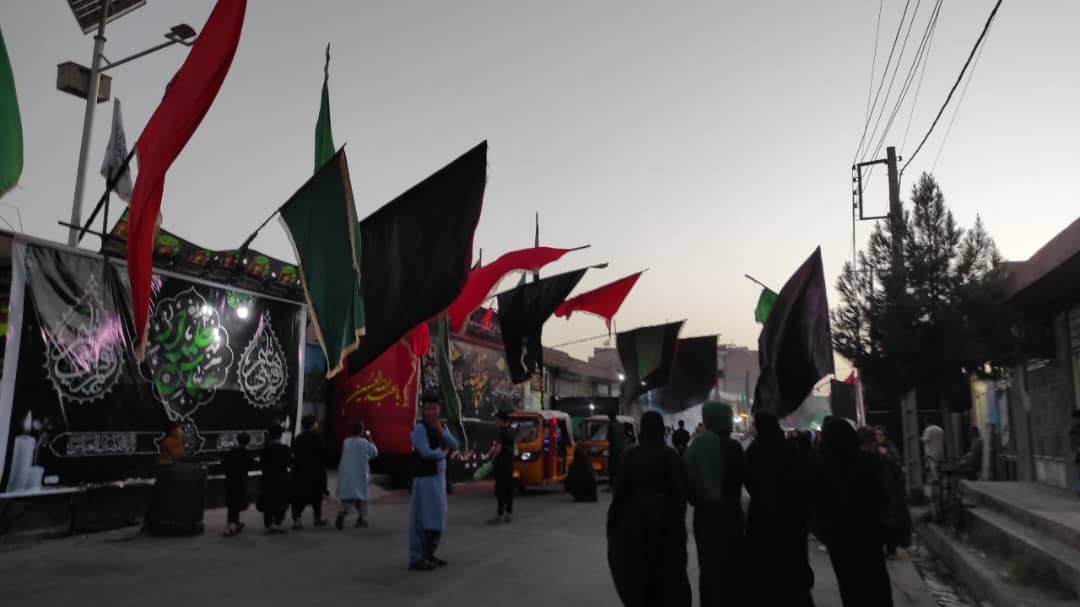
Since the Taliban returned to power, representatives of religious minorities and some other religious communities in Afghanistan say restrictions on their religious practices and ceremonies have increased. They say these limitations have affected Shia Muslims, Ismailis, Hindus and Sikhs.
In Kabul, Shia Muslims say restrictions on Ashura (Muharram) ceremonies have continued for nearly five years, with the Taliban imposing various limitations on public mourning events under different pretexts.
A Kabul resident who uses the pseudonym Mohammad Tamim Salehi says that this year, as in previous years, Taliban restrictions prevented people from installing Muharram gates and flags in public areas, setting up water distribution points for passersby, and traveling between mourning gatherings at different takya-khanas at night.
He describes these limitations as part of what he considers discriminatory treatment of Shia Muslims by the Taliban. According to him, the group is seeking to further narrow the space available for Shia religious expression.
“Since the Taliban returned, they have restricted Shia religious ceremonies in public places,” Salehi said. “In the past, these ceremonies were held on a much larger scale, but now they have been limited. This shows that the Taliban do not respect other religious groups.”
Habibullah, a resident of Kabul’s Dasht-e-Barchi area, says the Taliban have recently collected books related to Hanafi jurisprudence, Ismaili beliefs and Jaafari jurisprudence from some bookstores and public libraries. He also says the teaching of Jaafari jurisprudence has been removed from university curricula.
He says the Taliban’s treatment of Shia Muslims and other religious groups has deepened divisions between the authorities and Afghan citizens and weakened the culture of acceptance and coexistence.
He calls for the removal of restrictions on Muharram ceremonies.
“By restricting religious ceremonies, the Taliban are trying to increase divisions among people,” Habibullah said. “They have once again violated people’s freedoms, especially religious freedom, and they do not respect people’s beliefs.”
Beyond restrictions affecting Shia Muslims, Ismailis and followers of Jaafari jurisprudence, Hindus and Sikhs in Nangarhar province also say their religious practices have been limited.
A member of the Sikh community in Nangarhar, who requested anonymity, says that under the previous government, Hindus and Sikhs in Afghanistan were able to celebrate their traditional and religious festival of Vaisakhi freely and hold their ceremonies without major restrictions.
According to him, large Vaisakhi celebrations were held in Kabul and particularly in Jalalabad, but such events have faced restrictions since the Taliban takeover. He says many members of the Hindu and Sikh communities have since left the country.
He says that before the Taliban returned to power, Vaisakhi was a major celebration of colors and joy that lasted nearly a week, especially in Nangarhar’s Surkh Rod district, but those celebrations have now come to an end.
“Today, very few Hindus and Sikhs remain in Jalalabad, and our gurdwara has also been closed,” he said. “The Taliban have told us that we cannot hold religious ceremonies. In the past, we held our religious events every year without problems, but now we are not allowed to do so. Our request is that restrictions on religious ceremonies and freedom of belief be lifted.”
Meanwhile, the Human Rights Division of the United Nations Assistance Mission in Afghanistan (UNAMA) said in its latest report on Afghanistan’s human rights situation that pressure on religious followers and minorities has increased and human rights violations continue.
UNAMA said the Taliban had closed 33 Ismaili Jamaat Khanas in Badakhshan province. According to the organization, the Taliban justified the closures by claiming that the buildings resembled mosques.
The UNAMA report said that among the closed Jamaat Khanas, 17 were located in Zebak district, 14 in Ishkashim district and two in Wakhan district.
Representatives of religious minorities say that continued restrictions on religious ceremonies and freedom of belief would not only affect minority communities but could also further damage social cohesion and trust among Afghanistan’s diverse communities.