
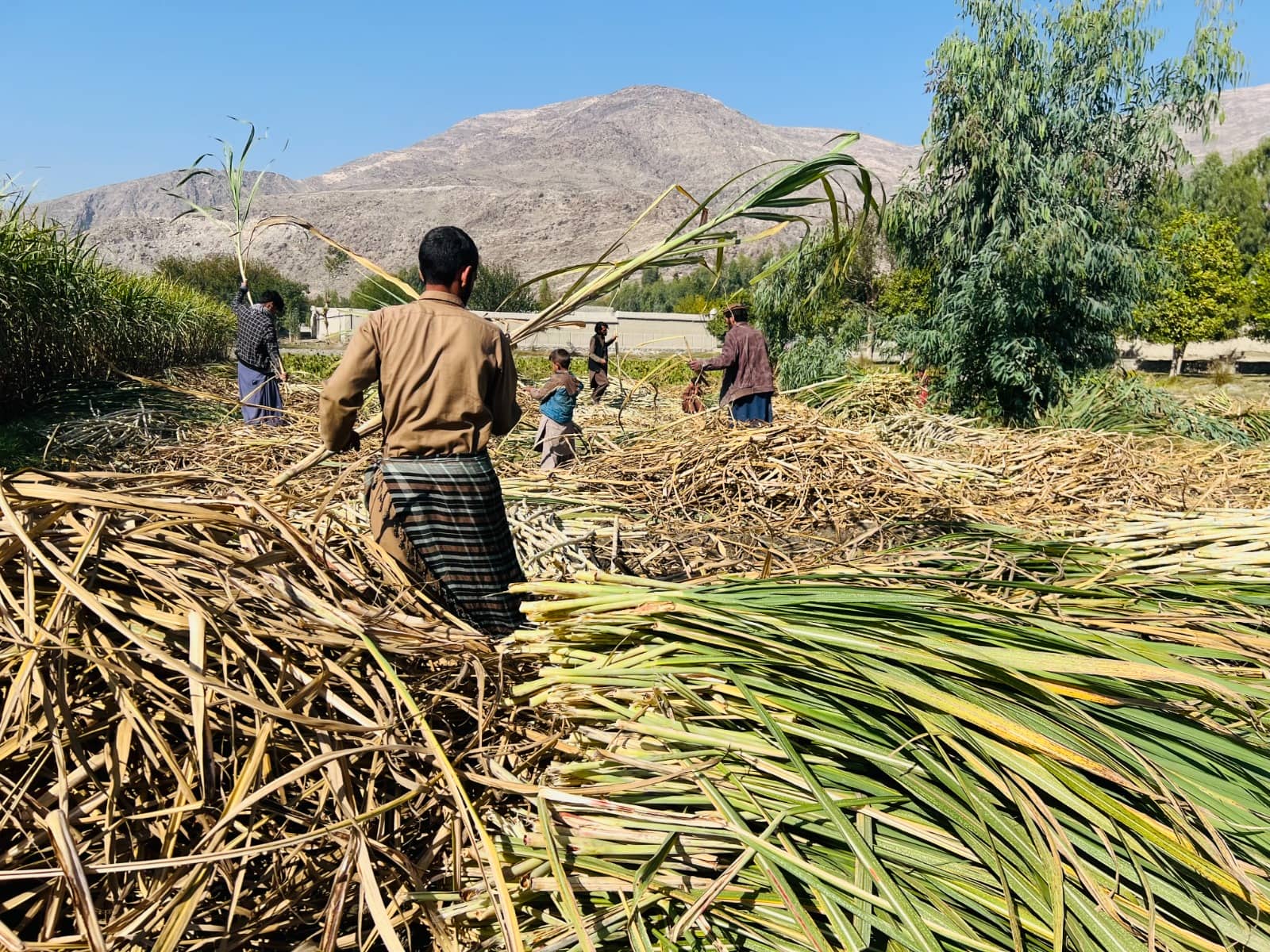
Persistent droughts and water shortages across Afghanistan have significantly reduced agricultural production, leaving farmers and orchard owners in several provinces facing serious economic challenges. Farmers say drought has not only damaged wheat, corn, and fruit production, but has also forced many of them to shift toward alternative crops that require less water.
Matiaullah, a resident of Goshta district in Nangarhar province, who is harvesting his corn crop, says climate change and years of drought have severely affected agriculture and orchards in the area.
He says drought over recent years has reduced the productivity of their farmland by half, and many farmers this year have been unable to cultivate parts of their land due to a lack of sufficient water.
“Due to untimely rainfall, floods, and water shortages, the yield of every crop has been reduced by half. If we previously harvested 60 maunds (around 420 kilograms) of corn from one jerib (a traditional Afghan land measurement unit), now it does not even produce 10 maunds (around 70 kilograms),” he says. “If we had enough water, our harvest would be larger and its quality would be higher. The yield has declined so much that it does not even cover our expenses.”
Matiaullah warns that if farmers’ problems are not addressed, many families could face severe economic hardship and food insecurity.
He says providing timely irrigation, improved seeds, and chemical fertilizers is essential to achieving better harvests.
He calls on agricultural support organizations to build reservoirs, dams, and check dams in different areas to store rainwater and floodwater and improve farmers’ access to water.
“Drought has severely affected wheat and corn because there was not enough water and rainfall to irrigate crops on time,” he says. “If improved seeds, chemical fertilizers, and check dams are provided, the problem of water shortages can be reduced to some extent. Otherwise, the situation will continue to worsen day by day.”
Zainullah Tarkhil, a farmer from Deh Sabz district of Kabul province, says local farmers have been forced to irrigate their lands on a rotational basis due to drought and water shortages.
He says yields of many crops have declined because of the lack of water, and rice fields have also disappeared. As a result, he has turned to corn cultivation because it is relatively more resistant to water shortages.
According to him, repeated droughts have left some lands unable to produce crops, and he struggles to meet his family’s basic needs. He warns that if the situation continues, many farmers may be forced to leave their areas.
“Water has become so scarce that we irrigate our lands on a rotational basis. If one jerib previously produced 80 maunds (around 560 kilograms), now it produces only 30 maunds (around 210 kilograms),” he explains. “This is not even enough for our family’s food, let alone selling in the market. We are facing the threat of displacement because of drought.”
Farmers say declining agricultural production has sharply reduced household incomes and left many families unable to afford food, improved seeds, and chemical fertilizers.
Agriculture experts warn that because Afghanistan’s economy largely depends on farming, continued drought will seriously affect the livelihoods of millions of people and could contribute to increased poverty, unemployment, and new waves of migration.
Agriculture expert Mohammad Arif Gholami says reducing the impact of drought requires water storage projects, providing farmers with drought-resistant seeds, and expanding modern irrigation systems, particularly drip irrigation, to ensure more efficient use of water.
He adds that Afghanistan’s capacity to store water is significantly lower than that of other countries in the region, making the country more vulnerable to drought.
“Afghanistan is going through a difficult period because drought is increasing day by day,” he says. “The main focus for institutions and farmers should be building fundamental water storage systems, including check dams, and cultivating crops that require less water.”
Meanwhile, the Food and Agriculture Organization of the United Nations (FAO) has expressed concern over worsening drought conditions in Afghanistan, saying the impacts of drought have spread to 19 provinces, with northern areas among the most affected.
According to the organization’s report, the loss of agricultural production, drying up of grazing lands, and depletion of water sources have pushed rural communities toward economic collapse.
The United Nations Office for the Coordination of Humanitarian Affairs (OCHA) has also warned that Afghanistan faces serious risks to agricultural production due to unprecedented drought, extreme heat, and climate change.
According to OCHA, the crisis has negatively affected agricultural production, pastures, drinking water supplies, and livestock.
“In Badghis, Ghor, Faryab, Sar-e-Pul, Samangan, Baghlan, Takhar, Badakhshan, Daikundi, Bamyan, Parwan, and Kabul provinces, rainfall levels were below average, temperatures were higher than normal, and soil moisture had significantly declined,” the report states. “This situation negatively affected wheat production, while livestock also faced risks due to shortages of animal feed.”
Afghanistan, where a large portion of the population depends on agriculture for their livelihoods, has been severely affected by drought in recent years. Persistent drought is no longer only a challenge for agricultural production; it has become a serious threat to rural incomes, food security, and the future of farming communities across the country.