
Monday, June 8
I sit with my back against the wall, following the news. I watch videos recorded by ordinary people, and each one brings me to tears.
I remember telling my sister yesterday that I wished I could let my hair loose, let the wind play with it, and wander through every corner of my city. I wanted all the streets of Herat to see me with my hair uncovered and free.
Standing before the mirror, trying to tuck every strand beneath my scarf, I say to her, “Maybe in the next decree, we won’t even be allowed to leave our homes.”
She shakes her head wearily and tells me to say Bismillah and go.
My mother, worried, says, “As soon as you reach the main road, put on your chadors. Not here. The neighbors are already saying, ‘Look at those girls who used to talk about freedom. See how quickly fear made them obedient enough to wear the chador.'”
Shopkeepers and passersby stare at my sister and me when they see us wearing mantos.
I overhear one of them saying, “The Taliban are taking women who go out without a chador.”
Another replies, “They imprison them for months.”
I quicken my pace, eager to pass them and avoid listening to these men who have never stood beside the women in their lives.
A few steps later, my sister hails a rickshaw and gives the driver our destination.
“Do you have chadors?” he asks. “Yesterday they took many women away.”
“Yes, we do,” I answer sharply.
As he urges us to put them on, he tells us about a woman the Taliban detained near the Qasr e Herat market. They handed her baby to her husband and told him, “You go home. We’re taking your wife.”
And that is exactly what they did.
I shake my head in disbelief.
“How easily they said it,” I murmur. “‘You go home. We’re taking your wife.’ How could her husband simply stand there and watch them take her away?”
It feels as though a great stone has been placed on my head. My head aches. My eyes feel heavy.
Then I catch my reflection in the rickshaw’s mirror. I look terrified. Fear has seeped into every part of me. There is no stone on my head—only a chador. I touch it. It is light. It isn’t heavy at all. So why does it weigh on me like this? Why does it feel as though the weight of this chador is slowly shutting down my mind?
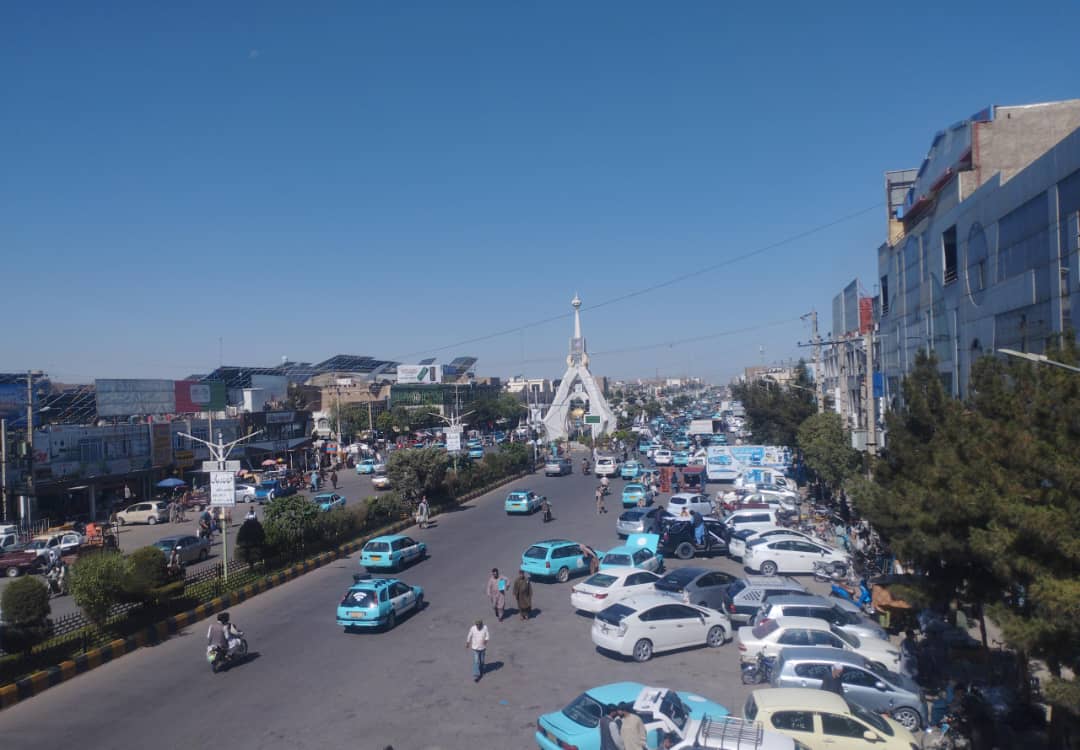
I look outside. There are no women. I tell myself it is still early. It’s only nine in the morning. Surely, in a few hours, the city will fill with women and young girls.
Before we even reach Shahr e Naw, I get out of the rickshaw and wrap the chador tightly around myself. Men look at us strangely. There is nothing in their eyes—no shame, no sorrow, not even satisfaction. They seem detached.
I scan the streets, almost demanding to find a woman or a girl without a chador. But there are none. I feel betrayed by a city that has been taken over entirely by men.
I turn to my sister.
“Why are there no women?”
Her body is here, but her mind is somewhere else.
I ask her again.
Annoyed, she replies, “Are there any women left in the city? The Taliban took them all yesterday. Nobody dares come out anymore.”
She suggests we walk to Chawk e Golha.
The weather is still bearable. We want to see the city. We want to keep the city from becoming completely devoid of women. It is not yet ten o’clock, and the heat is still mild. Yet I feel as though I am inside a furnace. Inside a bread oven. Beneath this chador and manto, I am burning.
Thinking of ovens reminds me of my mother baking bread a few days ago.
“May God protect us from the fires of hell,” she said.
I asked her, “Mother, can the fires of hell really burn hotter than a bread oven?”
I don’t know about hellfire. But today, in the heat of Herat, this chador feels exactly like my mother’s baking oven.
I turn to my sister.
“Mother says the oven’s heat is nothing compared to hell. If we’re not already in hell, then where are we?”
And silently I ask myself: If this is not hellfire, then what is this fire that I am burning in?
On our way to Chawk e Golha, three or four young women pass us. Long mantos. Masks. Chadors. They seem almost like robots. They walk without expression, without reaction.
I am afraid the women of Herat died on Friday, after the new decree was announced following prayers.
At Chawk e Golha, my eyes fall on a man in uniform. The sight of him makes me sick. My breathing tightens. I hate sharing the same air with him. Is he a guardian? No. He is a harbinger of death.
I stare at him with fury as he carefully watches the handful of women still moving through the streets.
I look around, searching for those white vehicles—the ones that carry women away.
I spend an hour waiting for my sister at a clinic. I’ve taken off my chador and placed it beside me, but I keep it within reach in case a Taliban member appears. The weather is hot. For a moment, I lower my mask. A quiet, gentle-looking girl sits beside me. She looks up at me and says anxiously,
“The Taliban’s decree says they’ll also take women who wear makeup. Why are you wearing lipstick?”
I rub my lips hard with the corner of my scarf.
Looking into her worried eyes, I reply,
“Good. It’s gone now. What else are they going to find fault with?”
She looks at me sadly.
“I wasn’t judging you. I was worried about you. Otherwise, what do I care whether you wear lipstick or not?”
I know I’ve snapped at her unfairly. She has done nothing wrong. She is just like me. A victim. As I prepare to leave, I tighten my chador and look at her again. This time she returns my gaze without expression.
“I’m sorry,” I tell her. “I was harsh. These past two days have left me on edge.”
She smiles.
“Go. May God be with you. Take care of yourself—and pray for all of us.”
I want to ask her: How? How am I supposed to take care of myself? I was already being careful. How much more careful can I be?
We’re close to home now. But the chador is still on my head. I’m afraid to take it off. I want to walk past the neighbors wearing it and let them think fear has finally broken me. Then a voice tears me away from my thoughts.
A man rides past on a motorcycle, shouting at the top of his lungs: “Hijab! Hijab! Hijab!”
I want to tear off the chador and scarf. I want to let my hair loose and run. Let the wind play with it. Let every man and every Taliban fighter stare at me.
Let tomorrow’s television broadcasts announce:
“A young woman in Herat removed her headscarf in protest.”
Let me become tomorrow’s headline.
But then I remember what my mother said before we left:
“Take care of yourselves. Don’t make me worry.”
By: Shahla