Table of Contents
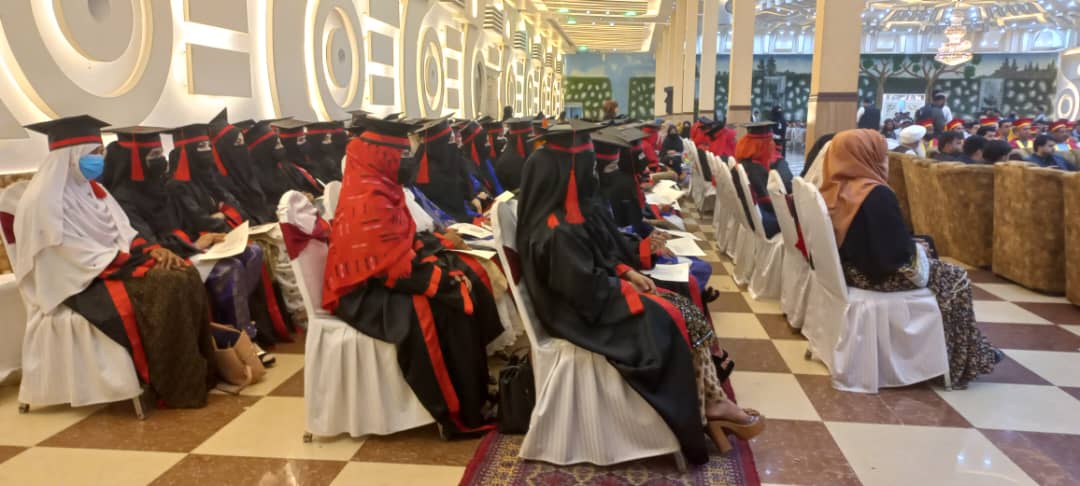
Over the past five years, women have been pushed out of Afghanistan’s universities in two distinct capacities: first as students, and later as professors and academic staff. The process was gradual. In the months after the Taliban returned to power, universities remained open to female students, but new rules were introduced to separate women and men. Restrictions then expanded to women’s choice of fields of study and their access to university facilities. In December 2022, the Taliban imposed a blanket ban on women’s university education. Female professors were subsequently barred from teaching and entering their workplaces, followed by a wider wave of dismissals from public universities.
Separating Female and Male Students
One of the Taliban’s first changes to higher education was the separation of female and male students. On September 12th, 2021, Abdul Baqi Haqqani, then acting minister of higher education, announced that universities would no longer allow women and men to study together. He said women’s classes had to be separated from men’s, and that where female instructors were unavailable, women could be taught from behind a partition or online. The Taliban also announced mandatory hijab requirements and a review of university curricula.
At some universities, segregation was implemented through separate schedules and physical spaces. Orders issued by the Taliban in September 2021 called for separate class times for female and male students and, in some cases, separate entrances. At some universities, curtains were also used to separate students inside classrooms.
The restrictions went beyond classroom segregation. Amnesty International reported that universities lacked the funding and personnel needed to implement gender segregation, disadvantaging female students. A female student at Nangarhar University said that, as a result of the Taliban’s segregation rules, women were forced to leave certain departments.
By 2022, restrictions had also reached women’s choice of fields of study. According to Amnesty International, in October that year the Taliban barred women from enrolling in a number of university fields, making subjects such as journalism, agriculture, veterinary medicine, engineering and economics largely or entirely inaccessible to women.
The Ban on Women’s University Education
On December 20th, 2022, the Taliban Ministry of Higher Education ordered public and private universities to suspend the education of female students “until further notice.” The order was implemented across Afghanistan’s public and private universities.
The Taliban cited issues including the mixing of women and men, women’s clothing, female dormitories and the content of certain academic fields to justify the decision. The ban remained in place, and women have not been allowed to return to universities. As of 2026, Afghanistan remains the only country in the world where girls and women are formally barred from secondary and higher education.
Female Professors: From the University to the Home
The ban on women’s university education also resulted in the exclusion of female professors. On December 22nd, 2022, just two days after the university ban, the Taliban Ministry of Higher Education ordered public and private universities not to allow women to enter their premises. The order explicitly included female professors and university employees, preventing them from teaching or reporting to work.
A study published in Studies in Higher Education found that female faculty members at public universities remained employed and continued to receive salaries after they were barred from teaching, although their salaries had been sharply reduced. The study adds that by October 2025, the overwhelming majority of these female faculty members had been dismissed.
Salaries Cut to 5,000 Afghanis
On June 2nd, 2024, the Taliban’s General Administration Office instructed a number of local government departments to reduce the salaries of female civil servants hired under the former government to 5,000 Afghanis (approximately US$75) a month, regardless of their rank or years of service.
The initial order was ambiguous, raising questions about whether the salary cut applied to all female civil servants or only to women who were unable to report to work after the Taliban takeover. The Taliban Ministry of Education also sought clarification from the Taliban leadership and, at one point, ordered a suspension of salary payments to women pending further instructions.
On July 7th, 2024, the Taliban Ministry of Finance clarified that women who reported to work every day would continue to receive their previous salaries, while those who did not report to work would receive 5,000 Afghanis a month. Ministry spokesman Ahmad Wali Haqmal said women who had been forced to remain at home would receive the reduced salary.
This clarification was particularly significant for female university professors, who were among the women barred from returning to their workplaces after the ban on teaching. In the same year, the European Union Agency for Asylum (EUAA) reported that the salary cuts meant that some women lost 75 percent of their previous income.
From Home Confinement to Dismissal
Keeping female professors at home was not the end of the process. In May 2025, the Taliban began a new wave of downsizing and dismissals of university academic staff. At Kabul University, academic sources told Afghanistan International that a list of 264 academic and administrative staff had been prepared for dismissal. The list reportedly included 170 professors, around 70 of them women. The sources said that all female employees at Kabul University, including professors and administrative staff, were on the dismissal list.
That same month, dismissals of female professors spread to other universities. The Afghan Women’s News Agency reported, based on a list obtained by the outlet, that 81 women had been dismissed from Herat University. Eight worked in administrative and financial positions, while the rest were academic staff. The highest number of dismissals was reported in the Faculty of Education, with 22 women affected.
Reports on the dismissal of female professors indicate that the process was not limited to a single university. Amu TV reported in May 2025 that the new wave of dismissals was spreading across public universities in Herat, Farah, Badghis, Ghor and Nimroz, with women accounting for a significant share of those targeted.
A UNESCO report on higher education in Afghanistan shows the broader scale of the loss of female academic staff. According to the report, 84 percent of female university teachers had left the university sector, compared to 34 percent of male teachers.
The Double Exclusion of Women
What has happened to women in Afghanistan’s higher education system over the past five years is not simply the loss of educational opportunities or employment. The Taliban have pushed women out of the university system both as students and as professors and researchers. As universities were closed to female students and female academics were gradually removed from the academic environment, women’s participation in both the production and transmission of knowledge was dismantled. The result is not only the exclusion of women from universities, but the systematic weakening of their role in producing, transmitting and reproducing knowledge in Afghanistan.